


Microsoft has been striving to assert its presence in the competitive device market for years. The company’s Surface suite spans a range of products, from foldable smartphones and 2-in-1 devices to traditional laptops and desktops. Its ambitious attempt even included the expansive Surface Hub, which has since been discontinued.
Despite these efforts, Microsoft has often faced challenges concerning battery life, performance limitations, and the perceived lock-in tied to its Microsoft 365 ecosystem.


However, the recent lineup of Surface for Business products aims to address these issues directly. After using one of these devices for several weeks, I can confidently say that Microsoft may have finally devised an effective formula for creating a remarkable working laptop.
Going Hands-On
Microsoft has tailored the Surface Laptop for Business specifically for enterprise customers, representing a significant refresh from its previous generation. The most notable enhancements include advancements in AI, security, device manageability, battery life, and repairability.
The device is lightweight and portable, weighing just over 1.35 kg, with a slim profile of only 0.69 inches, making it easy to slip into a rucksack or carry-on bag.
You May Like
The Surface Laptop for Business is visually appealing, featuring a polished black anodized aluminum chassis that stands out among the typical boring business laptops. The well-designed keyboard and touchpad offer ample space, enhancing the user experience.
(Image credit: Future / Mike Moore)
Microsoft has upgraded the hardware significantly in the Surface Laptop for Business. The device comes equipped with an Intel Core Ultra (Series 3) processor, up to 64 GB LPDDR5X RAM, and a maximum of 1 TB removable Gen4 SSD.
Significantly, it also incorporates AI-specific hardware. The Intel AI Boost NPU offers 50 TOPS of AI performance, enabling local AI processing. This can lead to improvements in battery life and overall performance of Windows. For highly demanding tasks like CAD, 3D rendering, or AI model training, a dedicated Nvidia GPU might still be necessary.
This enhancement aims to increase productivity and efficiency, and based on my experience, it certainly delivers. During a week-long overseas business trip, where I used it for conference keynotes, remote interviews, and site visits, the device excelled in speed, usability, and battery life.
However, my experience at home was less seamless. While I expected it to serve as the cornerstone of my home office setup, I encountered frequent connection issues with various devices, including monitors and Bluetooth keyboards. This could stem from driver-related problems, but it was frustrating nonetheless.
The absence of ports could be a drawback for some users. The laptop includes one USB-A port and two USB-C ports, which might complicate tasks for certain creators. Personally, I use a docking station, so I managed, but the occasional lack of responsiveness was a letdown. Moreover, the removal of the USB-A port from the charger block cable, which has proven invaluable in the past, is a disappointing change.
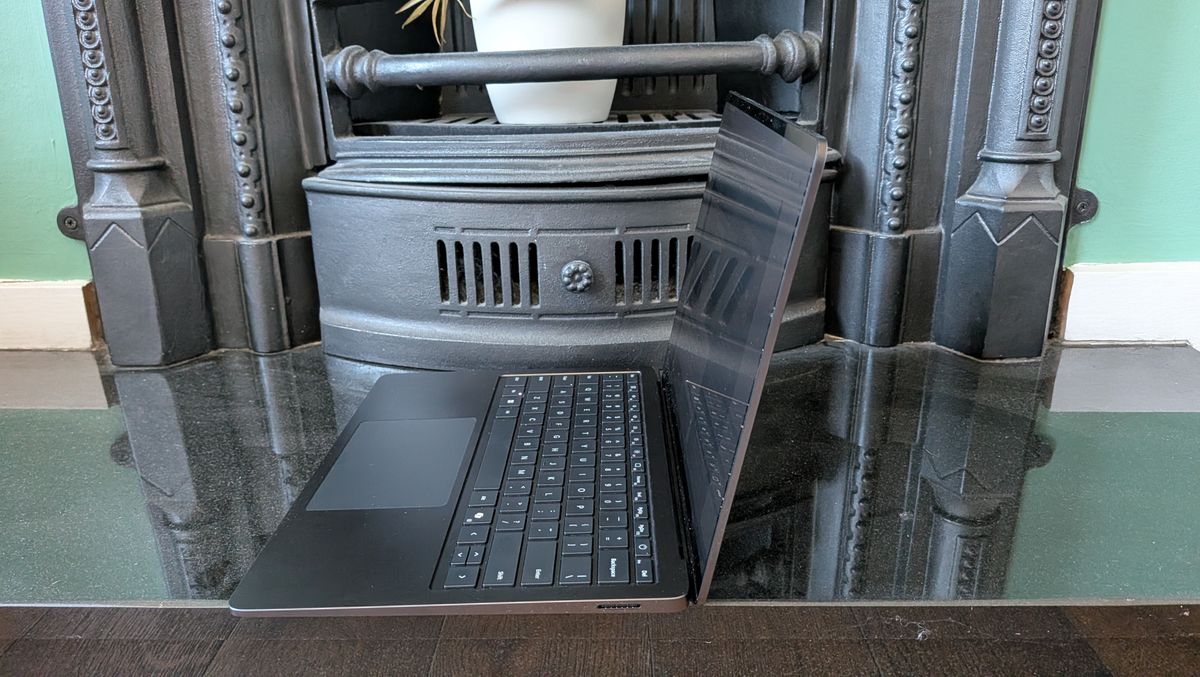
(Image credit: Future / Mike Moore)
Another significant advancement is the more sophisticated haptic touchpad integrated into the Surface Laptop for Business, which promises a more uniform click feel and enhanced gesture recognition. While it is somewhat smaller than my usual work device, the HP EliteBook, I found the touchpad to be exceptionally interactive, streamlining navigation across different applications and windows.
My unit also featured the integrated privacy display— a feature that caught considerable attention when unveiled in the latest Samsung Galaxy flagship smartphone. Activated via the alternate F1 function, this privacy display renders the screen hard to read from side angles, eliminating the need for external magnetic privacy filters. This is particularly helpful for professionals dealing with sensitive information, effectively preventing unauthorized viewing. Additionally, it includes an anti-glare coating, making it attractive for a wide range of users.
I Loved It—But Will You?
Is this the ideal device for everyone? Probably not. As a Surface product, it closely integrates with the Microsoft ecosystem, meaning those who rely on Microsoft 365 at work will likely enjoy a more streamlined experience compared to others.
The price point may also deter potential buyers, with my model starting around £1,599, and the highest-spec model reaching £2,499, which could be prohibitive for many startups and small-to-medium businesses (SMBs).
Nonetheless, I was thoroughly impressed with the Surface Laptop for Business—easily the best Microsoft device I have used for work. It has set a new standard in many aspects, and I’m optimistic about the opportunity to use it again in the future.

Follow TechRadar on Google News and add us as a preferred source to get our expert news, reviews, and opinions in your feeds.
For an in-depth look at the Microsoft Surface Laptop for Business and its features, check out the comprehensive review here.
Image Credit: www.techradar.com


