


Testing Google’s Claims: The Pixel Watch 5 GPS Performance
Tech companies are known for making bold claims, and Google’s announcement regarding the Pixel Watch 5 was no exception. Alongside promises of health, wellness, and Wear OS improvements, the company boasted about its new GPS technology, asserting it outperformed competitors like the Apple Watch Ultra 3 and Garmin Fenix 8 Pro in accuracy for exercise tracking.
Having previously used both the Apple and Garmin models, I was intrigued yet skeptical if Google would indeed deliver on this promise, especially given my mixed experiences with GPS tracking on earlier Pixel Watches.


With a chance to run the 2027 London Marathon, I saw this as a perfect opportunity to evaluate the Pixel Watch 5’s GPS capabilities. The challenging portion of the marathon route known for signal issues sparked my curiosity.
Equipped with my watches, I embarked on a train journey to the Isle of Dogs, an area notorious for its tall buildings and problematic GPS conditions. I planned to run miles 18-20 of the marathon course and then return to test the GPS functionality of the Pixel Watch 5.
(Image credit: Future / Mike Sawh)
Unpacking the Pixel Watch 5’s GPS Features
Before delving into the results of my test, it’s crucial to understand how Google claims its GPS tracking surpasses competitors. Like the Fenix 8 Pro and Apple Watch Ultra 3, the Pixel Watch 5 integrates dual-band GPS, which enhances its ability to communicate with satellites across two frequency bands. This feature is particularly beneficial when navigating urban areas with tall buildings, dense forests, or facing adverse weather conditions.
Notably, Google has enhanced its GPS tech by utilizing data collected from buildings in Google Maps, pairing this with AI algorithms to better account for where GPS signals may be disrupted. Furthermore, GPS reference stations scattered worldwide help mitigate the atmospheric factors that could impact tracking accuracy.
In this context, it’s important to consider the battery impact of GPS usage. To optimize battery life, Google has compressed the raw GPS data collected by the watch, processing it on a server and syncing this refined data to the Google Health app after workouts.
My Testing Methodology
I conducted two runs to evaluate the performance of the watches. The first run was on the marathon course from mile 18 to mile 20, followed by a route back. I recorded the data from my Garmin Fenix 8 Pro as it was the easiest to manage with a pre-uploaded course. My testing setup had the Pixel Watch 5 on one wrist and switched to the other for my second run, ensuring enough distance between the watches to avoid interference.
Using the native workout tracking functions on all smartwatches, I aimed for a side-by-side performance comparison.
Analyzing the Results
(Image credit: Future / Mike Sawh)
In my first run, the Pixel Watch 5 sat on my right wrist, while the Apple Watch Ultra 3 and Garmin Fenix 8 Pro were on the left. Post-run, I analyzed the data via IloveGPX. Even before zooming into the tracks, the Garmin’s data showed noticeable drift. The Google and Apple watches remained closely aligned, demonstrating reliable performance during the majority of the run.
Interestingly, I inadvertently extended my route due to partial blockages, but the three watches kept their data relevant to each other before diverging closer to the finish.
The distance recorded varied slightly between the watches, with the Pixel Watch 5 and Apple Watch Ultra 3 closely mirroring each other, while the Garmin registered a longer distance.
In the second run, wearing the Pixel Watch 5 on my left wrist resulted in it performing similarly well, especially as I approached the challenging buildings near Canary Wharf. The Pixel Watch 5 consistently managed to track my route more accurately than its competitors, although minor issues were still present.
Assessing Accuracy and Pace Data
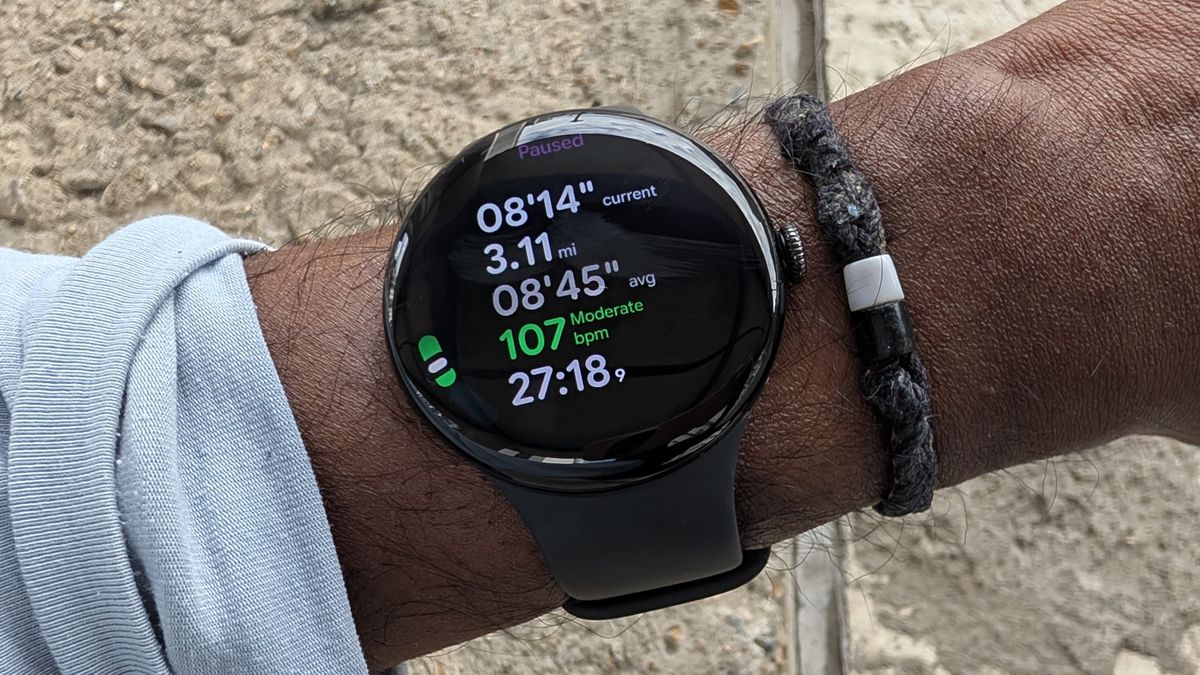
GPS accuracy directly influences not only distance measurement but also pacing. For those familiar with running events like the London Marathon, inaccurate data can skew performance insights. During all runs, I monitored current and average pace data across the watches, noting that the Pixel Watch 5’s pacing fluctuated initially but stabilized as I continued.
All three watches displayed similar pacing challenges early on but improved as they settled into the runs. Notably, the Pixel Watch 5 did indicate some unexpectedly quick paces as it logged my performance.
Conclusion: Is Google’s Claim Valid?
(Image credit: Getty Images)
I cannot definitively label the Pixel Watch 5 as a standout GPS performer based solely on two runs, albeit in challenging conditions. Yet, its reliability in routing was noteworthy. The Apple Watch Ultra 3 also performed admirably, while the Garmin Fenix 8 Pro stumbled in various spots.
For those focused on maintaining a precise running route, the Pixel Watch 5 could very well impress. However, when it comes to real-time pacing metrics, there’s still ground to cover for Google. Improvement in pacing accuracy could elevate user experience significantly in future models or updates.
The advancements in the Pixel Watch 5’s GPS suggest a promising shift in smartwatch technology, leveraging Google’s extensive data and AI enhancements. As I contemplate my gear for the upcoming marathon, it’s clear Google has provided valuable insights worth considering.

Follow TechRadar on Google News and add us as a preferred source to get our expert news, reviews, and opinion in your feeds. For more detailed analysis, check out the full article Here.
Image Credit: www.techradar.com


