


The Exciting Launch of Samsung’s Foldable Phones
The foldable phone faucet has just been well and truly opened. Samsung recently unveiled three new models at its London Unpacked event: two familiar faces and one all-new arrival. The Z Fold8 Ultra, Z Fold8, and Z Flip8 are three distinct takes on the foldable formula. Now that I’ve fondled all three, there’s a clear front runner that I’m genuinely excited to live with.
While it’s great to see Samsung finally letting the Z Flip8 run apps on its outer screen and the Z Fold8 Ultra’s bigger battery is a bonus, it was the pocket-friendly Galaxy Z Fold8 that I kept going back to in my pre-announcement demo session. The new shorter, wider shape is unlike anything else out there right now – and also feels like a return to the small phones many tech enthusiasts thought had gone forever.


Passports, please
Styling-wise, the Z Fold8 is a dead ringer for its larger sibling, which in turn isn’t too far removed from the outgoing Galaxy Z Fold7. Both retain Samsung’s angular shape, boxy corners, and conservative colour choices. Graphite, Cream, and Lavender make the cut this year, with the online exclusive Pistachio adding a subtle splash of colour.
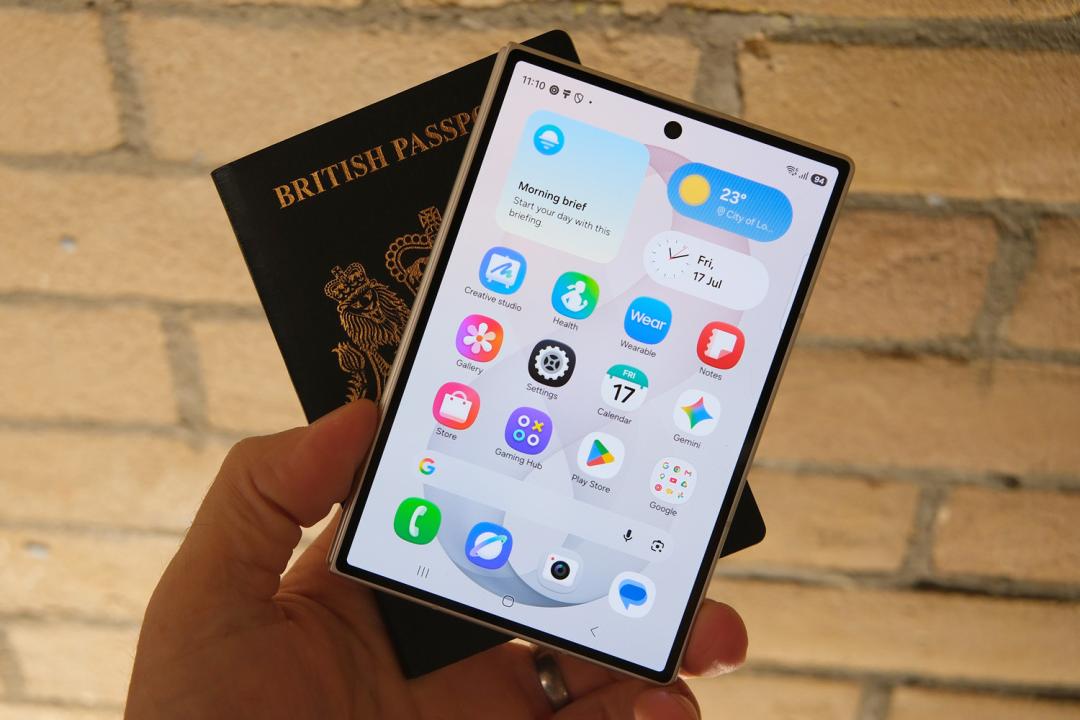
It’s the dimensions that truly make the Fold8 feel unique. The 5.5-inch outer display has a 10:16 aspect ratio, making it strikingly similar to the passport I had left in my travel bag for the briefing. It’s wide but not uncomfortably so—allowing me to hold it securely with one hand while reaching most of the screen with my thumb. Although apps might require a bit more scrolling due to the reduced vertical space, the interface never felt squashed, unlike the slender Galaxy Z Fold7.
This phone feels wonderfully compact in the hand when folded and is impressively light at just 201 grams. It slips easily into a pocket, evoking memories of the 2014 BlackBerry Passport, but without a physical keyboard taking up half the screen. The onscreen keyboard felt spacious; my initial typing experience suggested that I could compose messages faster here than on any traditional phone.
Strong magnets keep the two halves firmly held together when folded; opening it reveals a 7.6-inch inner display with a 4:3 aspect ratio. An all-new hinge design allows it to snap open with some force, meaning you can’t hold the Z Fold8 open at narrower angles like some rival foldables. However, this design choice effectively minimizes the crease, making it one of the hardest to notice in any folding phone I’ve tested.
The level of usability on the tablet-like landscape display feels significantly better than square foldables. I was impressed with how spacious apps appeared compared to typical book-style foldables. Browsing the web felt seamless, and I anticipate it will serve as a fantastic e-book reader. Even with letterboxed 16:9 content, there’s ample space for videos, meaning apps won’t feel cramped when run side-by-side in split view. Samsung’s Now Nudge also smartly suggests useful app pairs based on context.
Both screens are typical high-definition wonders with crisp resolution, high refresh rates, vibrant colours, and deep blacks. A peak brightness of 3000 nits and an anti-reflective coating are expected to maximize outdoor visibility, though I wasn’t able to fully test this in Samsung’s indoor demo area.
The bezels are not as astonishingly thin as those on some competitors, but they provide a comfortable space to grip without blocking the view of the content on screen. However, missing out on the Galaxy S26 Ultra‘s privacy display is a downside.
The Hardware Seems Suitably High-End
Samsung has chosen to streamline the Z Fold8’s system specs a little to let its bigger brother earn the ‘Ultra’ label. It’s equipped with a Snapdragon 8 Elite Gen 5 processor, alongside 12GB of RAM and 256GB of base storage. This sets the Z Fold8 on par with the best offers in 2026.
Last year’s model was already strong, and unless the silicon has to throttle excessively to remain cool inside the Z Fold8’s slimmer build, this device should perform impressively. Everything I tested on my demo unit opened swiftly, and multitasking was effortless. I’ll need more time with demanding games to assess its heat tolerance.
Concerning the battery life, the 4800mAh capacity is noticeably larger than the Z Fold7, and Samsung claims it can last an entire day without needing a recharge. Nevertheless, it’s worth noting that some rivals are managing to cram in 6000mAh cells. Hopefully, software optimizations will balance out this difference.
The charging speeds of 45W wired and 20W wireless are decent but not ground-breaking, representing a welcome improvement from last year’s models.
Can the Cameras Cut It?

The Z Fold8’s two rear cameras appear to be representatives from Samsung’s previous top-selling models. It features a 50MP main camera, comparable to the vanilla Galaxy S26, while the secondary 50MP ultrawide lens was utilized in the Galaxy S26 Ultra. Only the more expensive Z Fold8 Ultra includes a dedicated telephoto lens, leaving this version to rely on sensor cropping and digital zoom. The Ultra also leads in pixel count, boasting a 200MP main camera.
Samsung’s image processing algorithms do not seem to have undergone significant updates. Still, new software features like Dual Recording—which captures both your reactions and the scene in front of you—offer interesting functionality. Additionally, My FanCam uses subject detection recording with smart pan and zoom for a more seamless shooting experience.
However, it remains to be seen whether these features will convince photography enthusiasts to switch from more capable candybar-style handsets or from competitors like Honor Magic V6 and the Motorola Razr Fold, both of which feature three rear cameras.
Samsung Galaxy Z Fold8 Initial Verdict
Could this be the most exciting new Samsung phone we’ve seen in years? Anyone that found the Z Fold series too narrow previously will likely embrace the new form factor. The compact size when folded is a delightful throwback, while the expansive inner display feels fresh and inviting in ways that the more powerful Z Fold8 Ultra and streamlined Z Flip8 simply do not.
Moreover, the absence of a Western competitor offering a similar form factor at this moment means that the slightly reduced specs compared to other book-style foldables aren’t as significant. Although Samsung’s OneUI hasn’t seen any major enhancements from last year, it still remains one of the most feature-rich Android skins available. Being priced lower than the flagship Z Fold8 Ultra certainly adds to its appeal.
However, it’s still expensive at $1899/£1699 for the base model, meaning the cost of the 512GB and 1TB versions will stretch your budget significantly. The market’s reaction will be particularly interesting to observe once Apple reveals its foldable iPhone Ultra, likely featuring a similar form factor.
Until then, I’m not sure there’s an Android phone I’m looking forward to using more.
What Are the Galaxy Z Fold8’s Technical Specifications?
| Screen | 5.5in AMOLED (outer), 7.6in AMOLED (inner) |
| CPU | Qualcomm Snapdragon 8 Elite Gen 5 for Galaxy |
| Memory | 12GB RAM |
| Cameras | 50MP + 50MP ultrawide |
| Storage | 256GB |
| Operating system | Android 17 |
| Battery | 4800mAh |
For more detailed insights and the latest updates on Samsung’s foldable offerings, check out the full article Here.
Image Credit: www.stuff.tv


