


Our 8K Test System
Motherboard: Asus ROG Strix B850-I Gaming Wi-Fi
Processor: AMD Ryzen 7 9800X3D (8-core)
CPU Cooler: Corsair iCUE LINK TITAN 240mm
GPU: Nvidia GeForce RTX 5090 FE
Storage: 1TB WD_Black SN7100, 2TB XPG Gammix S70 Blade
Case: Acer Predator MI900
RAM: G.Skill Trident Z5 Royal Neo 96GB DDR5
PSU: Corsair SF1000
Screen: LG 55NANO966PA
After DOOM: The Dark Ages launched earlier this year, I’ve been eager to test its performance on our 8K rig and see how the monstrous Nvidia RTX 5090 handles this latest entry in a legendary gaming franchise.


Various delays held me back, but now, with significant graphical upgrades and enhanced support for Nvidia’s RTX 5000 series, including features like path tracing and Multi Frame Generation, the moment is ripe for testing.
The incorporation of path tracing adds depth to lighting, shadows, and reflections. Multi Frame Generation, powered by AI, is a game-changer for achieving high frame rates while retaining maximum graphic settings.
Now, it’s time to dive into DOOM: The Dark Ages to experience the latest visual enhancements and assess the RTX 5090’s capabilities at a remarkable resolution of 7680 × 4320.
What’s Path Tracing?
DOOM: The Dark Ages emphasizes both fast-paced gameplay and stunning visuals. Incorporating high resolution with intricate lighting effects can challenge even the most advanced GPUs, such as our test system’s RTX 5090.
Initially launched with ray tracing effects that are integral to its aesthetic, the game includes a recent update that enhances lighting realism with path tracing. Unlike basic ray tracing, path tracing allows light to bounce off multiple surfaces, resulting in profoundly realistic shadows and reflections, elevating the immersion.
However, this complexity comes with a substantial resource demand, making Nvidia’s Ray Reconstruction an essential addition. This feature uses AI to generate extra pixels and light rays, thereby alleviating some stress on the graphics card while maintaining image quality.
(Image credit: Bethesda)
Although AMD RDNA 4 GPUs can support path tracing, they lack a tool like Ray Reconstruction. So while the game looks impressive on those graphics cards, performance can be variable.
DLSS Stress Test
Given these advanced features are exclusive to Nvidia, it becomes clear that even the RTX 5090 requires DLSS and AI enhancements to maintain high frame rates alongside intricate Path Tracing effects.
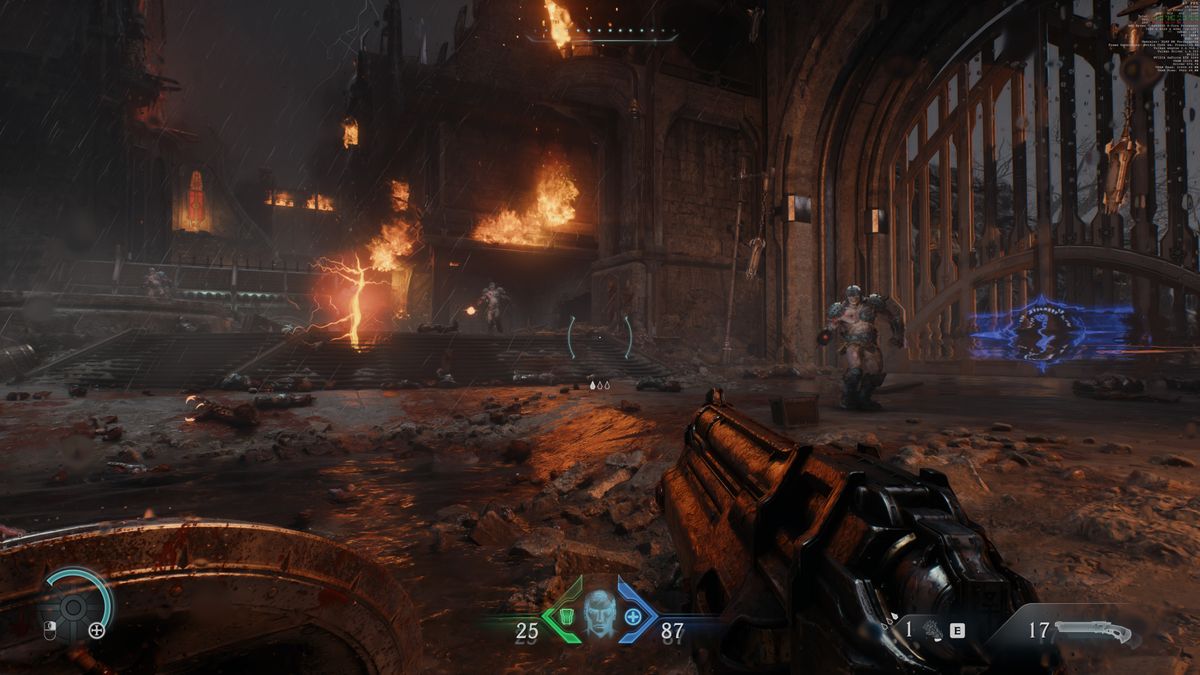
At 8K resolution with all settings maxed and DLSS set to ‘Quality,’ the average frame rate plummeted to 16fps—well below the desired 60fps. Even with DLSS, the lighting was too demanding.
(Image credit: Bethesda)
Determined to improve the experience, I explored additional options. Initially, Multi Frame Generation support was introduced in the latest update. While this technology employs AI to generate extra frames, it has drawn mixed reactions from gamers. When activated at its maximum setting of 4x, frame rates skyrocketed to 54fps despite creating a peculiar slow-motion feeling during gameplay.
I also experimented with DLSS set to ‘Performance’ mode, which rendered the game at a lower resolution and then upscaled it. This brought frame rates up to 83fps, returning the game’s energetic and responsive feel.
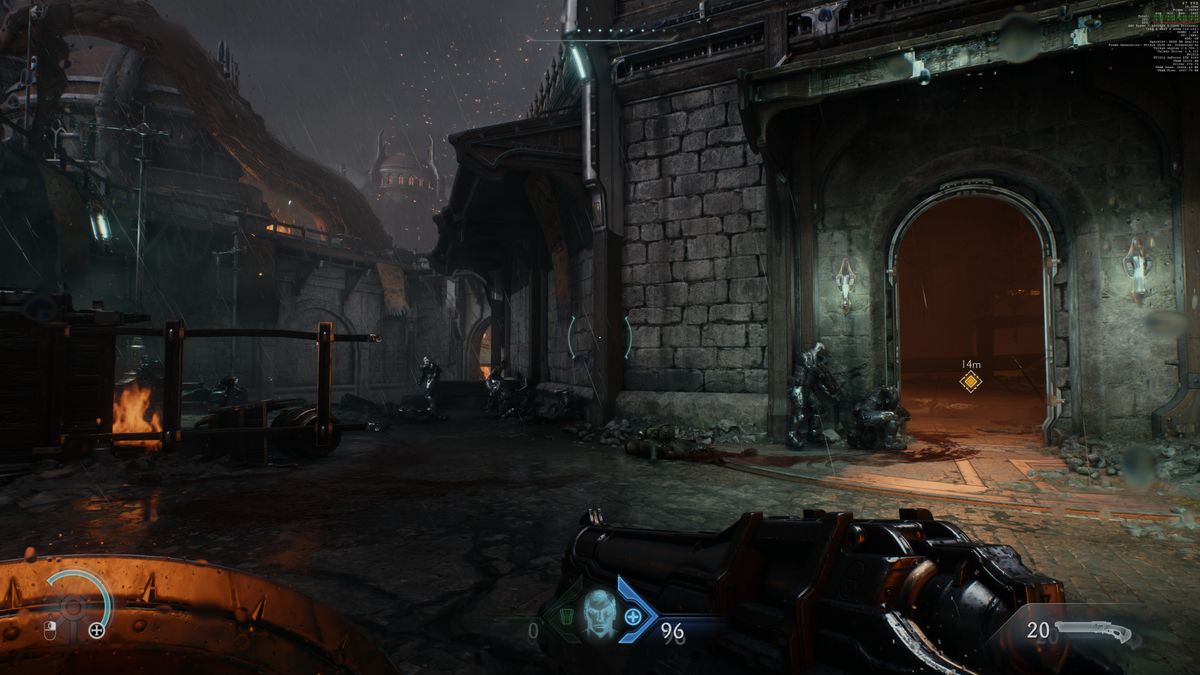
Turning off Path Tracing resulted in an astonishing performance boost to 143fps, showcasing how demanding this feature is even with Ray Reconstruction active. Returning to Path Tracing with DLSS set to Ultra Performance offered 145fps at 8K, though with minor image quality degradation.
(Image credit: Bethesda)
Given that my LG 55NANO966PA television maxes out at 8K resolution with 60Hz refresh rate, frame rates above 60fps don’t significantly enhance the experience. However, reducing the DLSS setting to ‘Performance’ found a solid equilibrium of image quality and gameplay.
Is Path Tracing Worth the Performance Hit?
Considering Path Tracing’s significant impact, does it justify being enabled if your GPU can handle it? For DOOM: The Dark Ages, which already excels in visuals and speed, the answer is affirmative.
The enhanced lighting effects contribute hugely to the game’s atmosphere, particularly in the shadowy realms of Argent D’Nur, where flickering lamps and candlelight play a substantial role in immersion. Projectiles illuminated by light sources also elevate the experience.
For players with less capable GPUs facing performance constraints, the trade-off may not be worth it. However, for those equipped with high-end graphics cards such as the RTX 5090, enabling Path Tracing unlocks a fresh layer of visual fidelity and immersion in a title that bridges the gap between PC gaming’s storied past and its promising future.
Today’s best Nvidia GeForce RTX 5090 deals
For a complete comparison and more on this topic, you can read the full article here.
Image Credit: www.techradar.com


