


The Art and Science of Problem Solving in Web Development
…and, worth repeating, it all looks exactly how I want it to look and behaves exactly how I want it to behave. Here’s another action shot!
The final product. She may not look like much, but she’s got it where it counts, kid.


Credit: Lee Hutchinson
Identifying the Issue
Equipped with a handy log colorizer, I became a digital detective, poised to uncover the elusive problems impacting my site. Within days, I pinpointed the root cause of an issue that had long lingered beneath the surface. Here’s the discovery:
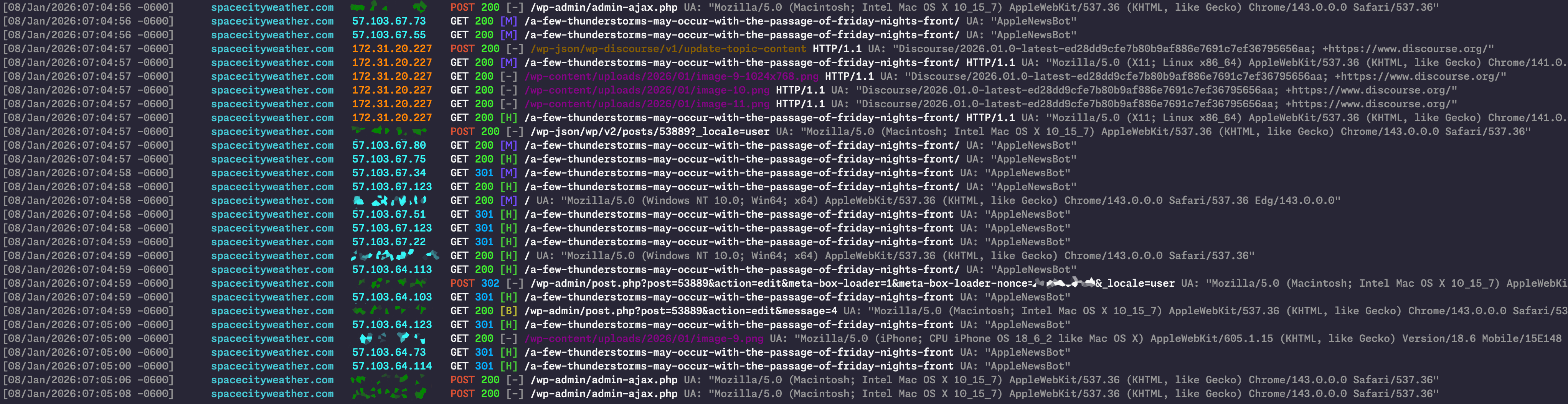
Problem spotted. Note the Apple News Bots hitting the newly published post before Discourse can do its thing and the final version of the page with comments is ready.
Credit: Lee Hutchinson
To summarize: While the issue seems to initially stem from Apple’s systems, it highlights a broader concern. Upon examining the sequence of events, we see how the publication process can inadvertently introduce complications.
In the timeframe captured in this screenshot, a series of actions unfold: Eric submits a daily forecast post, initiating a cascade of backend communications. This includes exchanges between WordPress and Discourse, culminating in the creation of a new comment thread tied to Eric’s post.
However, just after Eric presses “publish,” a different player enters the mix—Apple News bots. These bots, eager for fresh content, race to access the newly published article before the Discourse system can fully process the previous steps, leading to issues with content visibility and comment synchronization.
This race condition serves as a reminder that in web development and content management, timing and system interactivity are crucial. Understanding these dynamics enables developers to build more robust systems that can gracefully handle such interactions.
For further insights into this process and to understand the intricacies of log colorization and debugging methodologies, you can follow the full article here.
Image Credit: arstechnica.com


