


Apple Reclaims Leadership in Global Smartphone Market
In a remarkable shift in the global smartphone landscape, Apple has once again claimed the top spot, ending Samsung’s 14-year reign as the industry leader. New preliminary figures from the International Data Corporation (IDC) highlight a significant momentum change during the last quarter of 2025.
Quarterly Overview
During the final months of 2025, global smartphone shipments reached an impressive 336.3 million units, marking a 2.3% increase compared to the same quarter in 2024. This growth came despite ongoing supply constraints and economic pressures, suggesting steady demand across key markets.


Apple shipped 81.3 million iPhones in this period, securing a dominant 24.2% share of the global market. The robust demand for the iPhone 17 series propelled Apple to its highest quarterly revenue ever, signaling strong consumer interest as it achieved the best fourth-quarter growth since 2021.
Samsung’s Strong but Second Place Finish
Samsung, while slipping to second place, concluded the year on a positive note. The South Korean technology giant shipped 61.2 million phones, capturing an 18.2% share of the market. Notably, Samsung recorded annual growth of over 18%, making it the fastest-growing brand among the top five manufacturers.
Xiaomi held onto the third spot, with 37.8 million shipments and an 11.2% share. Vivo and Oppo closely trailed, shipping 27 million and 26.9 million units respectively, sharing the fourth position in the rankings.
Annual Market Dynamics
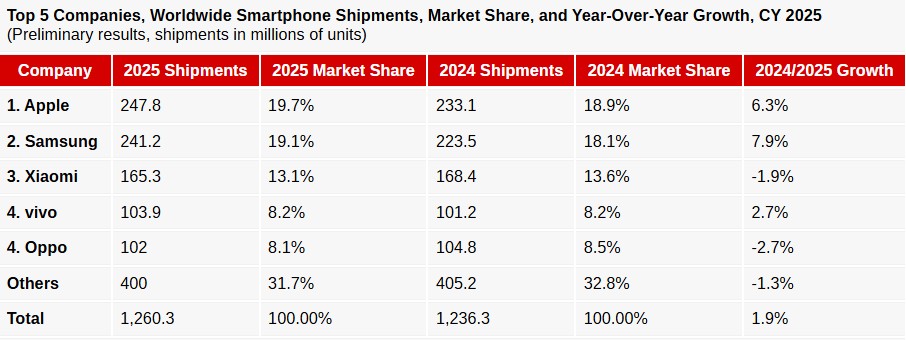
For the full year, the smartphone market shipped a total of 1.26 billion units in 2025. Apple led this quarterly tally with a record 247.8 million shipments, commanding a 19.7% global market share. This statistic highlights a remarkable trend: one out of every five smartphones shipped worldwide was an iPhone.
Samsung maintained its competitive edge with 241.2 million shipments and a 19.1% market share, logging a 7.9% annual growth. Xiaomi, with 165.3 million shipments, rounded out the top five alongside Vivo and Oppo, each surpassing 8 million units.
Despite a 1.9% market growth, challenges remain, including ongoing memory chip shortages and economic uncertainties. Tariffs and supply chain disruptions are significant concerns affecting the industry. Nevertheless, demand for premium smartphones remains robust, particularly as consumers anticipate future price increases.
Looking Ahead to 2026
As we move into 2026, the outlook for smartphone manufacturers may become more challenging. The lasting effects of the memory chip shortage could further strain supply chains, with analysts forecasting potential price increases. Larger brands are expected to retain a competitive advantage due to their scale and resources.
For further details, visit the source Here.
Image Credit: www.techjuice.pk


